Arpeggio shapes for songwriters
An arpeggio is a chord played one note at a time. A major arpeggio is the 1, 3 and 5 of the major scale. A minor arpeggio swaps the 3 for a b3. That is the whole rule. Once you have those three notes under your fingers in five different positions across the neck, you can write fingerpicked intros, top-line counter-melodies, lead lines that match every chord in your progression, and tasteful fills between vocal phrases without ever leaving the harmony you already wrote.
This page is the index. Five major shapes, five minor shapes, all anchored to the open chord shapes of the CAGED system. Pick one, click through, and learn it.
Audition arpeggios in the chord builder →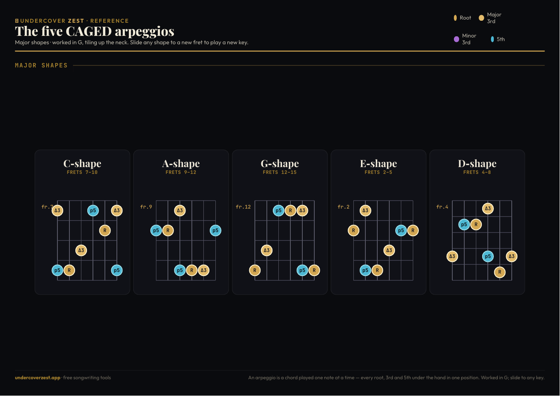
All ten shapes
The same C arpeggio, drawn five ways for major and five ways for minor. Each one anchors to one of the CAGED open-chord shapes and covers a different region of the neck. Click any shape for the deep dive.
Major arpeggios
Built from R, Δ3 and p5. Bright, resolved, the home tone of countless choruses.
Minor arpeggios
Built from R, b3 and p5. The flat third is the only difference. Same root, same fifth, same neck region.
The CAGED system, explained
CAGED is a way of mapping the entire fretboard using the five open chord shapes you already know: C, A, G, E and D. Each shape can be moved up the neck (sometimes as a barre, sometimes as a partial grip) to play the same chord in a new position. There are exactly five shapes for any major chord, and they connect end-to-end across all twelve frets before repeating.
An arpeggio is the same chord, but one note at a time. Each CAGED chord shape has a matching arpeggio shape that surrounds it, adding the higher and lower octaves of the chord tones. The C-shape arpeggio extends the C chord. The A-shape arpeggio extends the A chord. So learning the five CAGED arpeggios gives you the chord tones of any major or minor chord in any position on the neck.
On this site every shape is worked in G so they connect end to end across the neck. Low to high in G that is the E-shape at frets 2-5, the D-shape at 4-8, the C-shape at 7-10, the A-shape at 9-12 and the G-shape at 12-15, then it repeats an octave up. Move any one of these shapes to a different fret and it becomes the arpeggio of a different key, with the same fingering. The minor shapes occupy the same regions; only the third drops a semitone.
Major vs minor at a glance
The only difference between a major arpeggio and a minor arpeggio is the third. Everything else (root, fifth, fret position, fingering scaffold) stays the same.
Major
Bright, finished, the chord at the centre of pop and folk songwriting.
Minor
Wistful, contained, the chord that frames the slower verse and the heavier chorus.
A 15-minute daily practice approach
Five drills, three minutes each. Set a timer, do them in order, stop when the timer goes. After two weeks of this you will have all ten shapes under your fingers and you will start hearing them in songs.
Shape isolation
Pick one shape from the ten. Play it up and down at 60bpm with a metronome, one note per beat, six strings ascending then six strings descending. Three minutes. Watch your picking hand alternate. The goal is not speed; the goal is that every note rings clearly without buzz.
Shape connection
Take two adjacent CAGED shapes (C-shape and A-shape, or A-shape and G-shape). Play the first one ascending, then without a gap, slide into the second one and play it descending. Three minutes. This is the most important drill: connection is what gives you the whole neck.
Three notes over a held chord
Loop a single chord (C major, say). On top of it, pick any three notes of the matching arpeggio at random. Three minutes. The aim is to hear how each note sits against the held chord. The 5 sounds open, the 3 sounds resolved, the root sounds like home.
Ascending through three shapes
Start at the lowest C-shape on the neck. Play it ascending, then jump to the A-shape and continue ascending, then jump to the G-shape and continue. Three minutes. The aim is that the three shapes sound like one long line, not three little patterns.
Improvise a 4-bar phrase
Pick one shape. Over a held chord, improvise a 4-bar phrase using only the notes of that arpeggio. Three minutes. Don't worry about clever rhythms; just make a singable little melody. This is where the practice becomes songwriting.
Read deeper
Field Notes is the songwriting blog inside Undercover Zest. Marcus Vale's arpeggio series walks through each CAGED shape in a real songwriting context: the fingerpicking pattern under a folk verse, the indie-pop intro that loops one shape for four bars, the riff-as-melody that threads arpeggios through a held progression. Pair each blog article with the corresponding deep-dive page on this site for the visual reference.
For the chords these arpeggios extend, the full chord page is the next stop: G major, G minor, and for the progressions they decorate, browse progressions in G major.
More songwriting tools
Stuck on a lyric? RhymeForge finds the rhyme. Need to break a block with unexpected word pairs? Try CollisionLab. To map a full progression around these arpeggios, the interactive chord builder on the home page is the home base. All free, no signup.