Embellishing the open E chord
The open E major chord is built from 1, 3, 5. An embellishment moves one of those chord tones up or down on the same string to land on a different scale degree, producing a fuller, more colourful version that still resolves cleanly back home. This page shows the safe additions, the blue notes and the riskier single-finger moves you can make from the standard E shape.
All open-chord embellishments →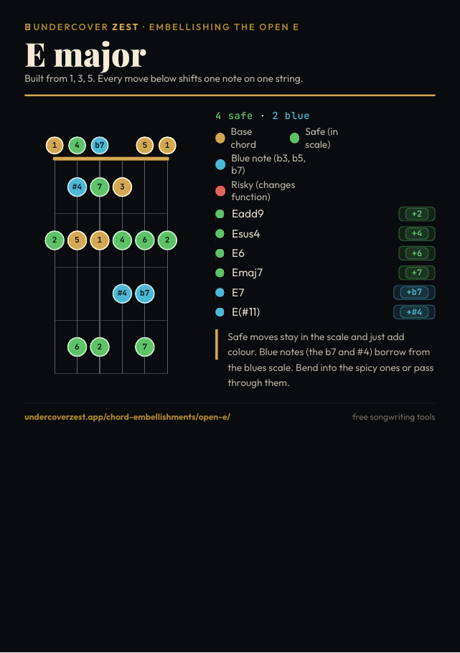
The base E shape
Here is the standard open E major chord with each note labelled by its scale degree. Compare this diagram against each embellishment below to see exactly which note moved on which string.
The plain E major shape with scale degrees labelled inside each note. Every embellishment below changes one of these notes on a single string.
Every embellishment at a glance
One map of the open E position. The gold notes are the chord you are holding; every other dot is a single-finger embellishment you can reach, coloured by type. Read it as a menu: any green, blue or red note is one move away.
- Base chord (1, 3, 5)
- Safe (in scale)
- Blue note (b3, b5, b7)
- Risky (changes function)
Safe embellishments · 2, 4, 6, 7
The safe additions for a major chord are the 2, 4, 6, 7 of the scale. They stay inside the major scale and create smooth voice-leading, so each one just adds colour. Every variant below moves a single note on a single string from the base shape.
Lift the D string from E up to F# and the chord opens out. The added 2 (F#) sits a major second above the 3rd and gives the chord a folkier, more weightless sheen. Common in fingerpicked acoustic songs in E.
Push the G string from G# (3) up to A (4). The 3rd disappears and you hear suspense waiting to resolve. Strum it twice, then drop the finger back for the resolve into plain E.
Hear the Esus4 →Raise the B string from B (5) to C# (6). E6 is bright and breezy, the chord of country two-steps and 1950s ballads. Try it as a once-per-bar accent inside a long E vamp.
Drop the D string from E (1) down to D# (7). Emaj7 hangs in the air with a wistful glow. Use sparingly: too long on the maj7 and the song forgets where home is.
Hear the Emaj7 →Blue notes · the bluesy colours
These are the blue notes: the b7, a bluesy dominant seventh, and the #4 (the b5), the blue fifth. They live just outside the plain triad, which is exactly why they sound expressive rather than wrong. Bend into them or pass through them rather than parking on them.
Open the D string entirely to land on D natural, the b7. This turns E major into a dominant 7, leaning hard toward A. Risky only because it changes the chord function: use it as a passing colour into the IV.
Hear the E7 →Push the G string up two frets to A#, the #11 of E. The 3rd vanishes, replaced by a floating Lydian colour. Park it inside an extended modal vamp and it shimmers; drop it into pop and it just sounds wrong.
Why these moves work
Every embellishment shown here lives inside the E major scale, so by definition it belongs in the chord's diatonic family. The safe additions, the 2, 4, 6 and 7, all sit a step or two from a chord tone, so they create smooth voice-leading rather than a jolt. The 2 and the 6 are pretty colours that don't change the chord's function. The 7 (the maj7) softens the tonic. The 4 sets up the suspension that resolves back to the 3.
The blue notes are the b7 and the #4 (the b5). The b7 turns the chord into a bluesy dominant that pulls toward the IV. The #4 is the blue fifth, the tritone that gives blues and rock their edge. Both live just outside the plain triad, so they sound expressive rather than wrong; bend into them or pass through them rather than parking on them.
How to practise
Start by gripping the standard E major shape and strumming four times. Then apply one embellishment at a time: hold the new shape for four strums, return to the base for four, and repeat. Get the muscle memory before you try to fit the move into a song. Once each embellishment feels easy on its own, try cycling two of them inside the same bar, for example base to add9 to base to sus4. That little four-step cycle is the engine of an enormous amount of acoustic guitar writing.
The other open chords
Every open chord, triad and seventh alike, has its own embellishment vocabulary. Pick the next one to explore.
More songwriting tools
For the full reference on this chord (voicings across the neck, theory, progressions, songs that use it), open the full E major chord reference. Need to drop these chords into a progression? The interactive chord builder on the home page maps every diatonic and borrowed option in every key. Stuck on a lyric? RhymeForge finds the rhyme; CollisionLab breaks a block with unexpected word pairs.