Simple open-chord embellishments
A major chord is built from the 1, 3 and 5 of the major scale. A minor chord is built from the 1, b3 and 5. An embellishment moves one of those chord notes up or down on the same string, landing on a different scale degree that produces a fuller, more colourful chord. Most moves are a single fret or two. This page lays out every open chord, the eight foundational triads and the nine common seventh-family shapes, with every single-finger embellishment for each, colour-coded into safe additions, blue notes and riskier moves. Click any chord for the full write-up with playing notes.
Try them in the chord builder →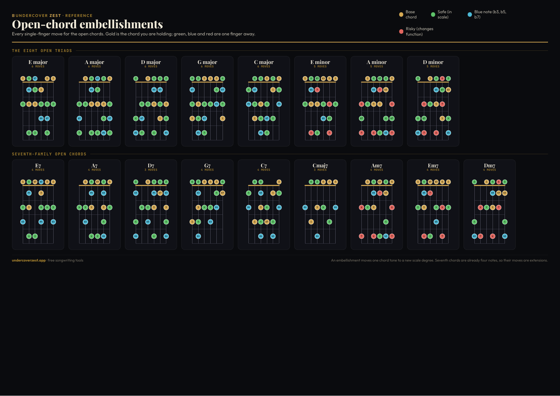
Three kinds of addition
Every single-finger move falls into one of three groups. Safe additions live inside the chord's scale and just add colour. Blue notes are the blues-scale tones (the b3, b5 and b7) that give a chord its grit. Risky additions change the chord's function or step outside the scale, so they need handling with care.
Safe
Blue notes
Risky
Every open chord, every move
One row per chord: the base shape on the left, then every single-finger embellishment beside it. The coloured dot marks the note that moved. Use the legend to read the colours; click any chord for the full write-up with playing notes for each move.
Why these moves work
Every safe embellishment lives inside the chord's own scale, so it cannot clash with the original chord tones: it just adds a new colour, a brighter, darker or more open voicing of the same underlying harmony. The 2 and the 6 are gentle additions that don't change the chord's function. The 4 sets up a suspension that pulls back to the 3. The 7 in a major chord softens the tonic into a maj7; the b7 in a minor chord is its natural seventh.
The blue notes come from the blues scale: the flat third, the flat fifth (written #4 here, since you usually fret it as a raised fourth) and the flat seventh. They are the notes that give blues, soul and rock their bite. Over a major chord the b7 and the #4 are blue notes; over a minor chord the b5 is the bluesy tritone. They sit just outside the plain triad, so they sound expressive rather than wrong, especially when you bend into them or pass through them.
The risky moves change the chord's function or step outside the scale without the blues pedigree. In a minor chord the natural 6 sits in Dorian and the major 7 in harmonic minor: used briefly they sound modal and beautiful, but held too long they erase the chord's centre.
Make a song out of them
Most of the songs you know already use embellishments without naming them. The trick is to apply them deliberately: pick one chord in a progression and embellish it once a bar, or cycle through two embellishments over a single chord for an entire verse. The interactive chord builder on the home page is a good place to audition what each move sounds like in context; RhymeForge and CollisionLab handle the lyric side.