Songwriting glossary
Twelve terms songwriters keep running into, each defined in one sentence and then shown at work in original examples. Every entry ends with a way to try the idea in one of the free Undercover Zest tools.
Rhyme
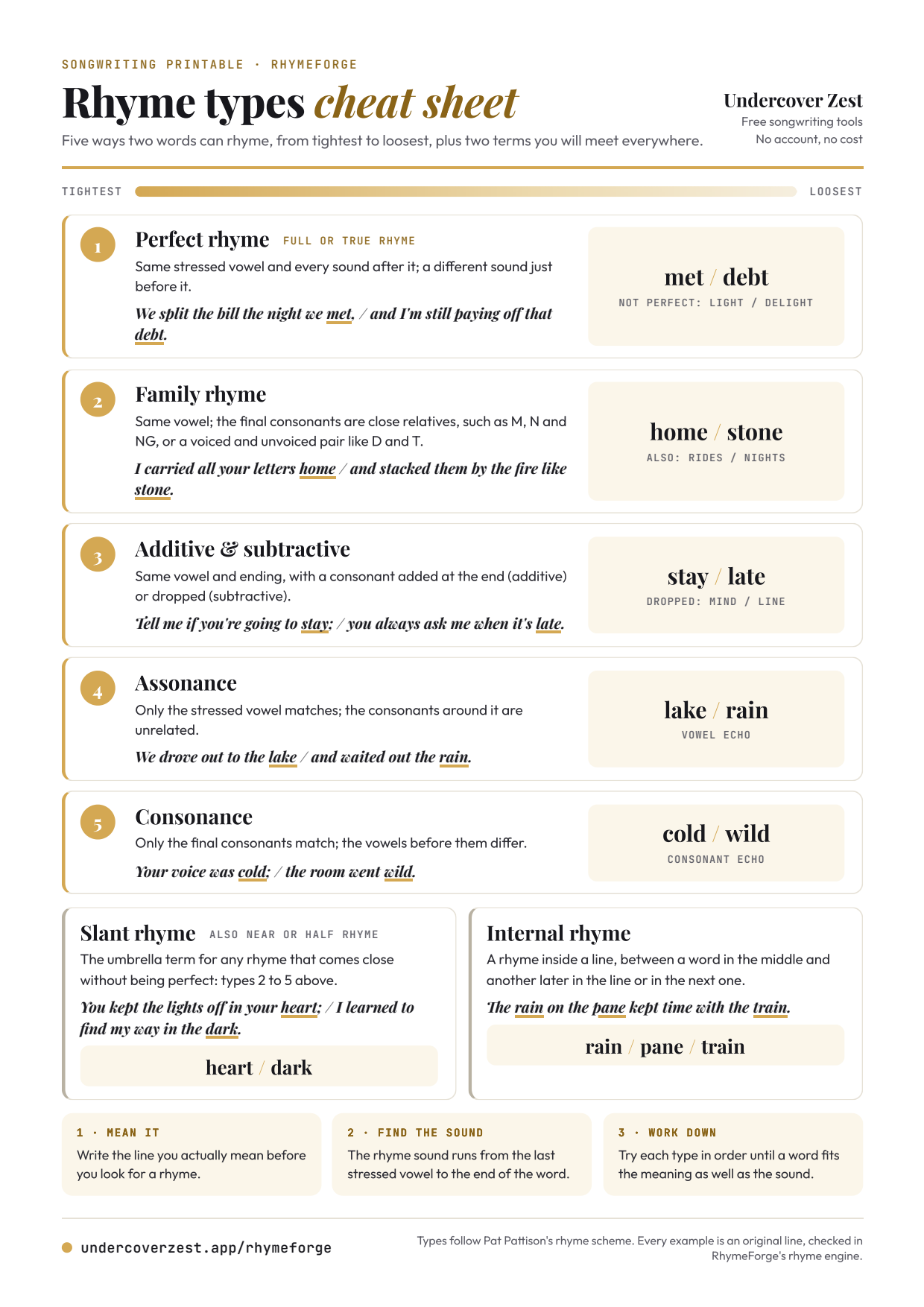
The rhyme types follow the scheme Pat Pattison teaches in his Berklee Online lyric-writing courses, which RhymeForge also uses to sort its results. The first six appear in the order RhymeForge lists them, roughly from tightest to loosest. Slant rhyme is the umbrella term for everything short of perfect, and internal rhyme is about where a rhyme sits rather than how close it is.
Perfect rhyme
A perfect rhyme is a pair of words whose sounds match exactly from the last stressed vowel to the end, while the sound just before that vowel differs, as in met and debt.
Family rhyme
A family rhyme pairs words with the same stressed vowel whose following consonants differ but are closely related sounds, as in home and stone, where M and N are both nasal sounds.
Additive rhyme
An additive rhyme pairs a word with another that has the same stressed vowel and end sounds plus one or more extra consonants at the end, as in stay and late.
Subtractive rhyme
A subtractive rhyme is the reverse of an additive rhyme: the second word keeps the stressed vowel but drops one or more of the consonants after it, as in mind and line.
Assonance
Assonance is the repetition of a vowel sound with different consonants around it; used as a rhyme, it pairs words such as lake and rain that share the stressed vowel but not the consonants after it.
Consonance
Consonance is the repetition of consonant sounds; used as a rhyme, it pairs words such as stone and rain that end on the same consonants after different stressed vowels.
Slant rhyme
A slant rhyme, also called a near rhyme or half rhyme, pairs words whose end sounds are close but not identical: the vowels match and the consonants differ, or the other way round, as in home and alone.
Internal rhyme
Internal rhyme is a rhyme between a word inside a line and another word later in the same line or inside the next one, as in rain, pane and train.
Lyric craft
Harmony
Chord examples are spelled out note by note and link to the Chord Builder, so you can hear each one.
Borrowed chord
A borrowed chord is a chord taken from the parallel key, the major or minor key with the same home note, to add colour, such as F minor in the key of C major.
Secondary dominant
A secondary dominant is the dominant chord (V or V7) of a chord other than the home chord, used to make that chord sound like a brief new home, such as D7 leading to G in the key of C.
Nashville Number System
The Nashville Number System is a way of writing chord charts in which each chord is a number for the scale degree of its root, so one chart works in any key: 1, 4 and 5 are C, F and G in C major, and G, C and D in G major.
Print it
Keep going
- Songwriting guides: step-by-step methods for slant rhymes, object writing, chord progressions and morning pages.
- Chord pairs: what to play after two common chords, with progressions to try.
- Which rhyme sounds have the most rhymes? A data study of RhymeForge's dictionary.